Many Russian soldiers reach the front by trains headed to Novorossiysk. Railway workers call the routes that terminate at this station the most extreme in the country. In the restaurant car, soldiers drink, fight, make marriage proposals, and weep. New Tab journalist Maria Polesskaya spent five days on a train traveling between the Urals and Novorossiysk. She tells a story of men who go to fight in the “special military operation” but discourage others from doing the same, and of the clash between female strength and male vulnerability in the dining car.
All names in this text have been changed
The original piece was published in December 2025.
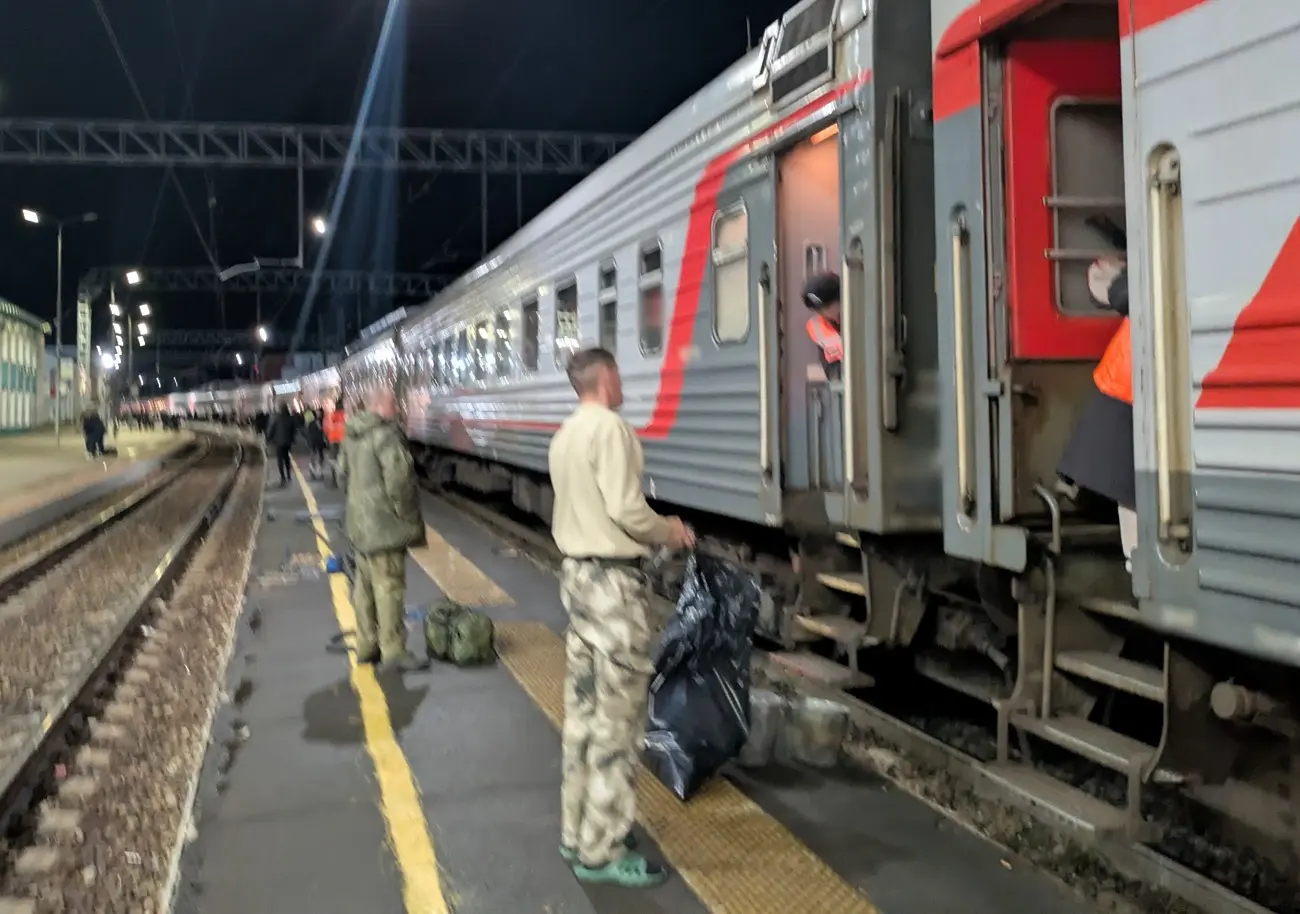
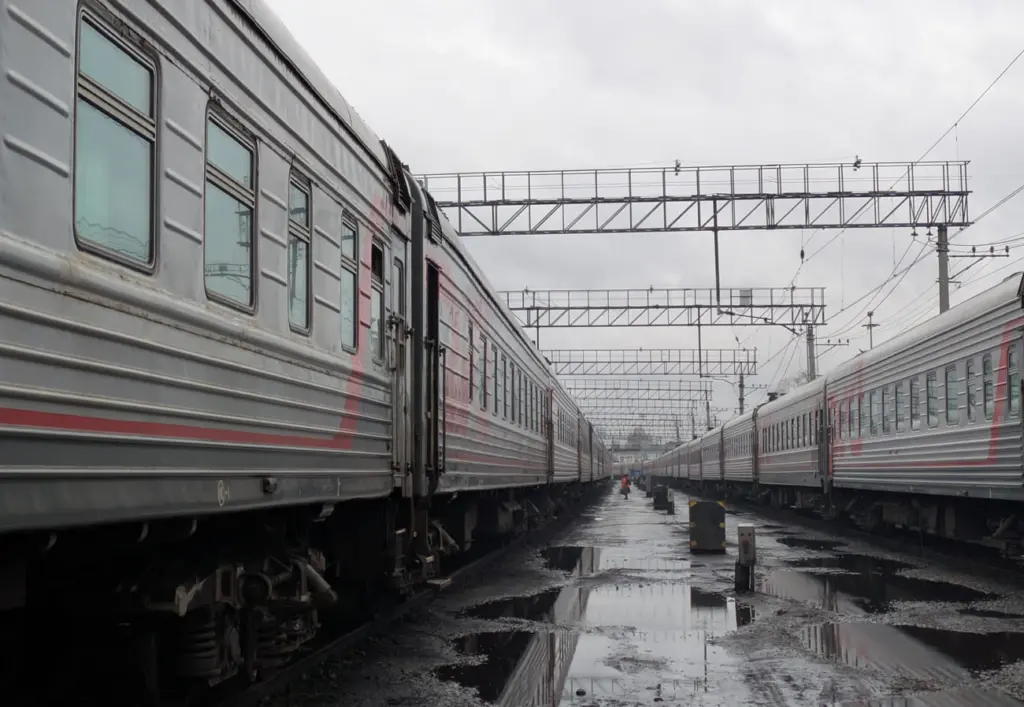
On the tracks, a ways away from the station, stand uncoupled dining cars. A few of them currently have no electricity — a technician switched off their generator earlier. Underfoot is black slush and mud.
“Oh, white sneakers, this’ll screw them up,” a railway worker says to me in passing.
You recognize the station by the smell of diesel, grease, and coal. The manager of the dining car, Irina, lights the stove herself in the galley and spends the night in the car — tomorrow, passengers will see her with her makeup already done, behind the bar counter.
Before the war, dining car workers considered the route to Novorossiysk the least profitable. They mostly transported children, which meant no alcohol and no tips. “If someone said ‘You’re going to Novorossiysk,’ it sounded like a curse,” Irina recalls.
Since the start of the war, everything has changed. There are now a lot of soldiers on the route, and with them come a lot of money and a lot of problems. Before my trip, instead of wishing me good luck, my editor sends me an article about how a “special military operation” (abbreviated “SVO” in Russian) veteran raped a female university student in a train bathroom. I didn’t expect a safe reporting trip, but I took precautions where I could.
“Just get off!”
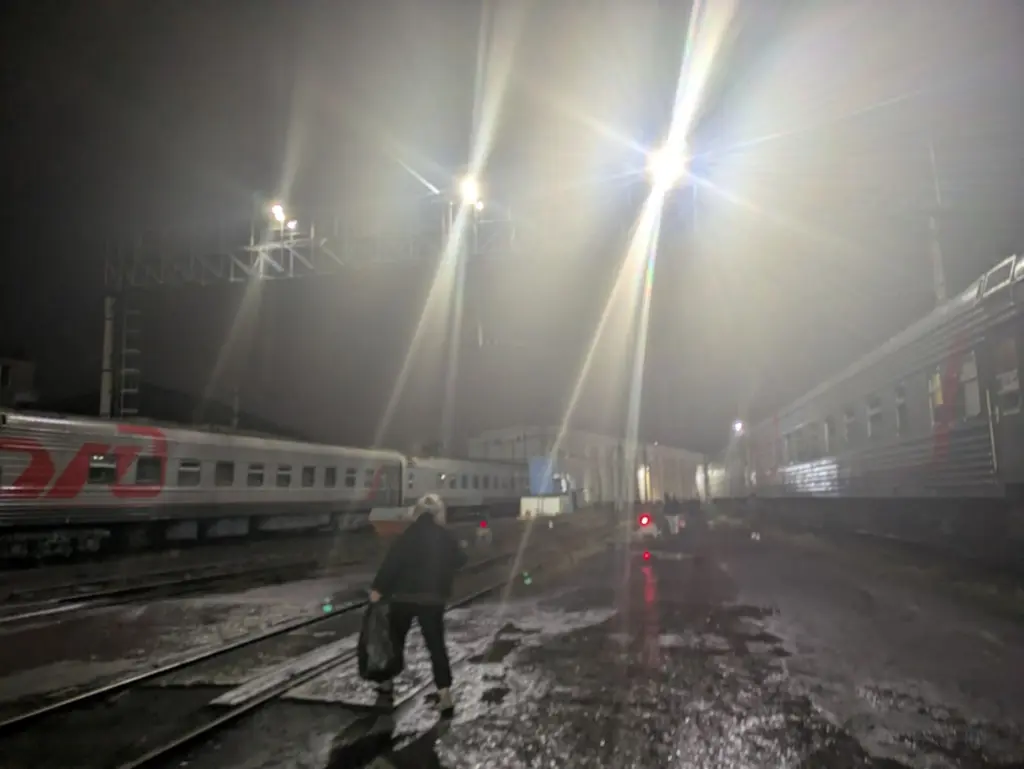
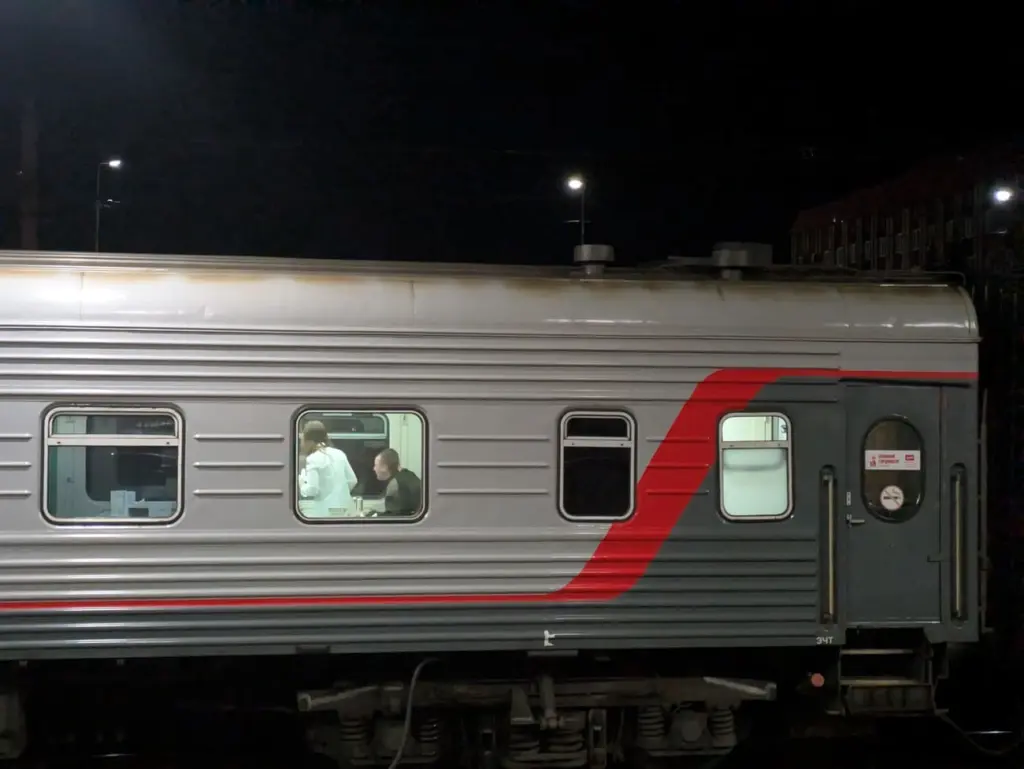
I’m not traveling with Irina but with a different dining car crew. The train departs in the evening, in darkness. The station is full of people seeing off passengers and relatives shout to departing boys in camoufalge:
“Take care of yourself!”
“Will there be cell service there?”
“Just make sure you write us!”
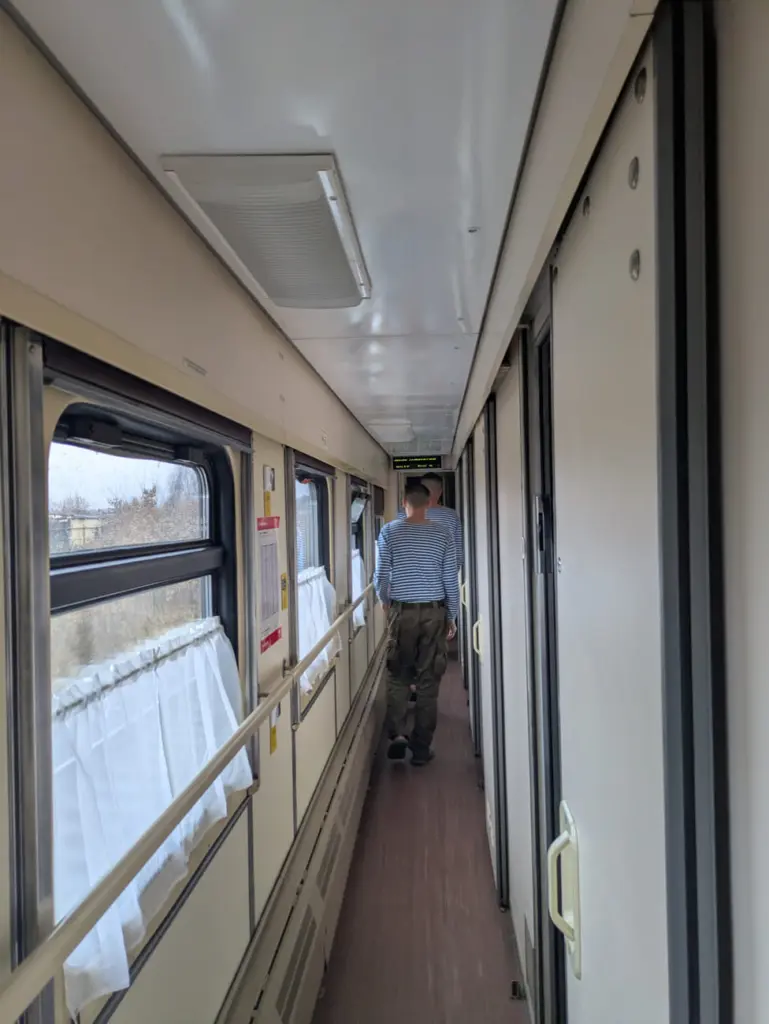
Scattered among the passengers in the car are a number of men in military uniforms who have already been to the war, guys with prosthetic limbs and injuries.
“In the first period after the war started there was still a clear contrast between how men went there and how they returned,” Irina told me. “Many went so happily, like children playing at war — now, everyone is exhausted. They can no longer return to a normal life.”

On that first evening, the restaurant is open for only 40 minutes.
One of the first visitors — a bald guy from Chuvashia with a prosthetic leg in a bright, multi-colored sleeve — hobbles up to a table. His first order is Syabry brand vodka. I introduce myself as a journalist, but he refuses to talk, citing his prosthetic leg as the reason.
“It’s not really interfering in conversation,” I retort.
“I won’t talk with you,” he says sharply and his face immediately darkens.
The dining car manager, Natalya, who has transported him more than once, warns me that “He gets aggressives very fast when he’s asked direct questions… The last time, he lost it when people started asking why he was going, for money or for ideology.”
But soldiers love to talk about themselves and generally spout off. This is not always convenient for the staff on the trains.
“Draftees especially like to talk about their woes. I have to respond, ‘I’m listening to you, but I have to work,’” Natalya explains. “One of them once stopped [another], like, ‘Don’t tell them that. Do you know what they’ll do to us for that?’ And the first guy said ‘I don’t give a shit what happens anymore!’”
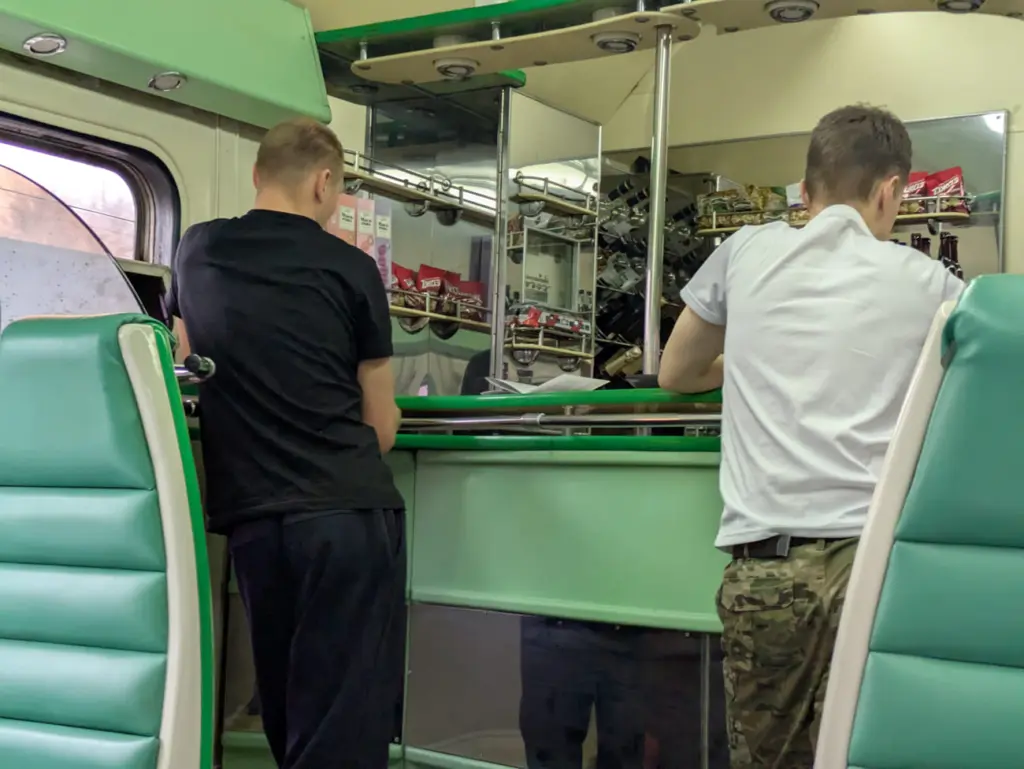
At some point, drunken groups get annoying and disruptive and you have to cut them off.
“You ask: ‘Do you love your country or are you in it for the money?’ Some will say honestly that it’s for money. Some beat their chests and say, ‘I would fight for free!’” Irina told me. “Basically all of them come from villages where it’s impossible to earn a living. More than 50,000 rubles at once is something they’ve never laid eyes on.”
Another passenger sits down near the man with the prosthetic leg. From their conversation, I gather that the first man in the car is going home, and the newcomer, who has a wife and four children at home, is headed to Novorossiysk and from there “to the SVO.”
“Children need a father, first and foremost. Why are you going there? Just get off, get on any other train before it’s too late! Just get off! You just need to change your mind,” the man with the prosthetic leg tries to persuade his interlocutor, taking a swig. He repeats the final phrase about seven times.
Before the dining car closed, he sat next to me and started flirting, asking what kind of wine to order, why I’m not married, and if we should get married right then and there. His eyes lit up for a moment at those words. Later, a psychologist would explain to me that when death hangs over a person, love becomes the simplest antidote — that’s why people throw themselves into it so easily.
“What year were you born?” asks the guy with the prosthesis.
“1997.”
“Me too,” he says, glowering and adding after a long pause “only now I’m without a leg.”
In an instant, his gaze becomes empty. He indifferently opens up a messaging app and demonstratively scrolls in front of me. On his phone are several chats with girls. The dialogues, as far as I can tell, take the standard form: “What’s up,” “I’m bored,” “send money.”
I start to get the creeps. I’d never seen such an empty gaze in someone my own age before.
“We didn’t fight for you for nothing”
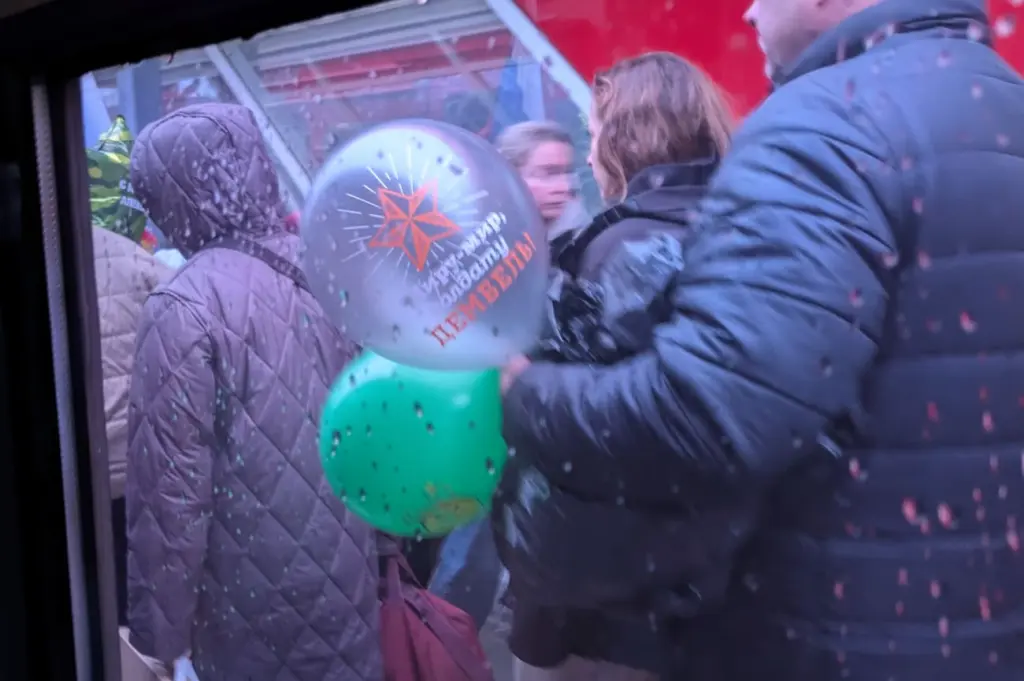
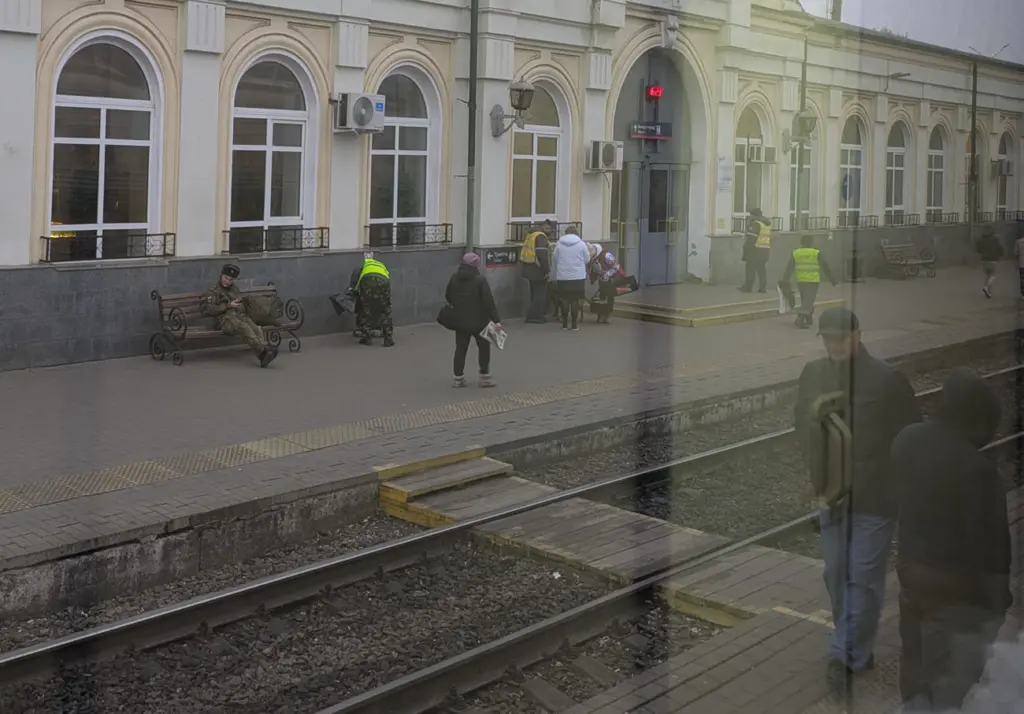
On the second day of the trip, the train stops in Kazan, and once again, just like in the very first station, there are crowds of relatives. In their hands are balloons: “Peace for the world, demobilization for the soldier!”
In the dining car, conscripts in telnyashkas (striped undershirts worn in the Russian military) and track suits eat kasha and drink juice, while an SVO soldier has been washing down his vodka with beer since early in the morning. Near them sit Ukrainian refugees: three women with three preschool-aged girls. Irina, the other dining car manager, was explaining to me that many soldiers and refugees go as far as Novorossiysk by train because ferries to Ukrainian territories depart from there.

“Women with children travel frequently, they’re evacuated from Luhansk, from Donetsk. They say, ‘We’ll return.’ I ask them, ‘To where? It’s still rumbling there.’ And they go ‘who cares, we’re sick of it here.’ There are many of these refugees,” Irina recalled sympathetically. “The route, of course, is full of such contrasts. It’s visible even in the stations. If you step off at Rossosh (A city and railway station in the Voronezh region), it’s life in peacetime; but on the other side of the station, it’s like the return of 1941: trucks, tanks, everyone in military uniforms. And the closer you get to there [the front], the more often you’ll see only camouflage on the streets.”
There aren’t enough tables in the dining car, so the refugee women with little children have to share with the soldier who’s chasing his vodka with beer.
“How’s Russia treating you?” he asks, after some small talk.
“It’s fine.”
“Glad to hear it, we didn’t fight for you for nothing.”
Two soldiers sit down at the table next to a man from Kharkiv. One has a telling nickname — Pig. The other one, Alexander, is more sympathetic, but is missing his front teeth. I overhear snippets of their conversation. The man from Kharkiv talks about fleeing from Ukraine to Russia. Pig recalls that the first time he stole something was in first grade.
There’s not enough room in the dining car, and Pig and Alexander relocate to my table. It’s not the first time they’re going to war. They say they’ll be serving in a supporting role 120 kilometers from the front lines, and that both of them are former prisoners who were released early by doing this. When asked about the war, they frown: “don’t bring it up” and “let’s not talk about that.”
“Sometimes you don’t like something but you can’t leave — it’s against our code of conduct,” says Alexander. Pig remembers trying to talk conscripts out of signing a contract: “People like them get killed in the first days — they’re just meat. We’re grownups, we have an instinct for self preservation, but those little thugs are enthralled by the money they’ll get if they’re wounded — that they’ll get 2.5 million.”
Alexander shows me his dog tag with his personal number, call sign, and blood type, and then he suddenly adds, “Did you copy everything down? Go ahead, report it to Ukrainian intelligence.” He went to fight for the first time two years ago, after his younger brother, who had been drafted by the Russian authorities, was killed in the war.
“I won’t say that I’m a patriot for my native land,” Alexander muses. “I hate it because of a certain president of ours, because he’s a miserable bitch. This is profitable for him. We’re just his torpedoes. I hate my life. I don’t want to live. But I’ll do this all for my kids. I’ll do it for my woman, so everything is smooth and beautiful. Why am I, at 50 years old, going to the front lines, on a convoy every other day, while the fucking children of your deputies are taking it easy?! These deputies get paid 850,000 rubles, and I’m risking my life for 249,000? Now people will return from the front. Someone’s wife cheated on him, someone went to a cafe and behaved inappropriately. All these penal colonies, like the ones that are currently closed in the Urals, will get filled up again and again. For the government, this is laying the groundwork for the future. They send us there [to war]. Ask yourself, with what kinds of minds do we come out of there? We see all of it there. There’s nothing good.”
Since 2023, State Duma deputies are not required to make public declarations about their incomes, so we don’t have reliable information about their current salaries. However, according to media reports, the income of the State Duma’s poorest deputy, who lives only on his salary, was around 500,000 rubles a month in 2022, and was expected to increase to 645,000 by 2026.
Prices are high in the dining car: 400 rubles for a can of Zhigulevskoye beer; 3,000 and change for a bottle of Tsarskaya vodka; 4,000–5,000 rubles for a bottle of Abrau Dyurso wine. Soldiers order a lot: a first course, a second course, a third course, and, of course, a lot of alcohol.
“We have a salary of 240 [thousand rubles] net, you do what you can with that,” explains Alexander. “Every six months we travel like this, and during that time you can also accumulate some bonuses. In general, we don’t complain. But then when you get home you don’t want to live.”
Talking with former prisoners is like walking through a minefield. Some questions elicit immediate aggression, others intense distrust. Still other, less dangerous questions lead, as with my previous interlocutor, to compliments and offers of sex or marriage. You have to be constantly on edge with them. You might be sitting calmly at a table, carrying on conversation, even smiling, but inside you a calculating machine is working constantly, scanning the space, intonations, glances, possible reactions.
In the dining car the fear is palpable. The confined space, the table that makes it impossible to just stand up and leave: you’re trapped between the window and a man. You think constantly about what will happen if they see your voice recorder, get suspicious, or react badly to a question.
As soon as Alexander steps out to smoke, Pig sits next to me.
“To be honest, here in the restaurant is the last chance to relax” he begins, already quite drunk. “The only thing we don’t have enough of is female attention. Are you willing to give a little to us? It won’t cost you anything. And it will benefit us. Tomorrow we’re going into battle, fuck, and no one knows how it will end. Can I ask you a direct question? Will you come to our sleeping car? Look, here’s the thing. One more, one less — there’s no difference. Anyway, who is there to choose from here?”
When he comes back, Alexander isn’t pleased with Pig’s behavior.
“If I see you with her again, I’ll twist your head off. Get out of here! You almost crushed her with your weight.”
“What, did you team up with her or something? I don’t fucking get it.”
“You’re going to bed now. If you look at her again, I’ll rip out all your tonsils.”
After a verbal altercation, Alexander and Pig get into a fistfight. I used to think that I was triggered by aggression. I could burst into tears just from a tram conductor shouting at me. But on the train, the fear is somewhat blunted. You suppress your emotions, because otherwise it’s impossible. You return to the dining car, continue conversations, make it look like everything is fine, and at the same time you notice: the person across from me is getting drunk, the aggression is rising, time to leave. But you need to do this calmly, not abruptly, so that no one notices you’re leaving.
The friends scuffle a bit, then make up. Their attention once again switches back to me.
“I figured out what she’s doing,” Pig says to his friend in a loud, ingratiating whisper. “It’s the same thing you and I were doing in the nineties. A pretty girl scamming suckers. But we’re not suckers.”
“Well, I really like her lips,” Alexander chimes in loudly. “Such Ukrainian-looking [he uses a derogatory term] lips.”
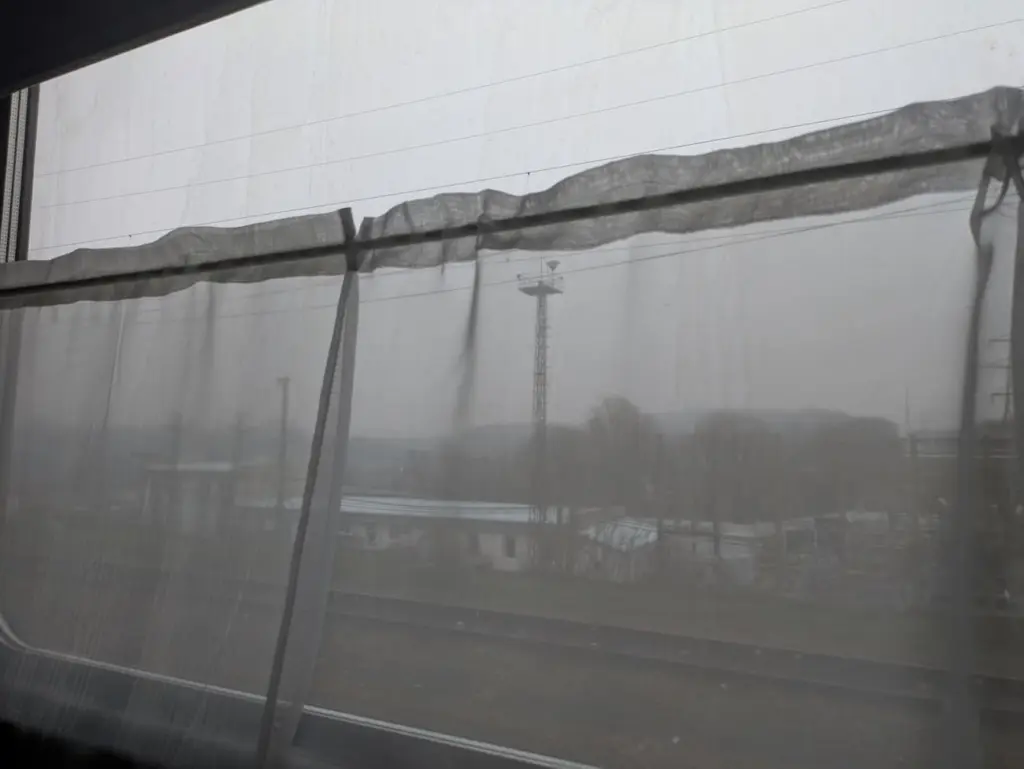
I realize that the situation is escalating and I hurry to leave. I hide in my sleeping compartment, climb into the top bunk, and barely breathe. I cover my head with the translucent sheet: for some reason it seems like they won’t find me under there. There was nowhere to go. And anyway, no one would protect me.
Later I learned that once they were totally drunk, the former prisoners became firmly convinced that I was a criminal who drugs victims, and would spend the remaining 24 hours of the trip searching the train cars for me. Fortunately they didn’t find me.
“This is their logic: if they buy something, or if a girl just sits with them and smiles, they think it’ll be given to them for a cup of tea,” a server explains to me. Unlike her, I at least have the option of leaving. No one on the staff — not the manager of the dining car, not the server, not the cook — can do that.
“I bring you food, I bring you drink”
A dining car is essentially a food service operation on wheels. That is, all the problems that exist in food service are doubled here. It’s the only car on the train that doesn’t belong directly to Russian Railways (the state-owned national rail company). It is in fact a separate business. Dining cars are operated by an LLC called KTA. The company hires dining car managers, who are mostly women. These managers then assemble their own team — they find a cook, a security guard, and sometimes a server. If there’s no server, the dining car manager takes over that part of the job herself.
“We’re already on wheels, damn it, and the demands placed on our restaurants are so incredibly high,” Irina complained to me. “This is a job in food service that’s constantly moving and shaking. Can you imagine trying to make soups here? Or chopping salads?”
The cook on this route does get up very early, at 5:00 in the morning. “I was in the kitchen from 6:00, and I only managed to get to the toilet at 1:00 p.m. During the day I basically eat nothing, maybe just a couple spoonfuls of salad that were left over somewhere. To avoid throwing it away, I toss it back myself, that’s how I eat,” he says during a break.
According to workers, you earn two to three times more here than “on the ground.” Rates can vary by route. The dining car manager decides who gets paid how much. For example, a cook can earn 30,000 rubles for one trip to Novorossiysk. In a month, that’s five trips at 30,000 each, or 150,000 rubles total.
“We work for a month, then we relax for a month. And we eat here for free,” explains one railroad employee. But there’s nonetheless a shortage of workers: few are willing to work on a train, with no phone service, with this clientele and in these conditions.
Routes to Novorossiysk during the war years have proved even more lucrative. “I’ve never earned this much in my life as I do here with soldiers, because they just don’t consider money,” Irina admitted.
The following day, when I say to the other dining car manager, Natalya, that I’m afraid to go to the restaurant because there are former prisoners in there shouting about how I’m going to drug them, she waved it off. “Oh, come on, fuck them. What are they going to do?” She’d seen worse in her life.
Her colleague Irina tries to appeal to the consciences of soldiers she interacts with:
“I have to argue with some of them. It gets to the point that you ask them, ‘How old is your mom? Well, I’m even older. Why are you talking to me like this? I bring you food, I bring you drink. I clean up after you, after all. Let’s be a little more respectful.’”
“They’re adrenaline junkies,” Natalya agrees. “They don’t understand a kind word, they understand a team and herd mentality. You have to be harsh with them, not because I’m so mean, just because it doesn’t work any other way.”
“They all carry cash with them, but they try to grab less, because if they grab a lot they’ll drink it all away,” Irina told me. “And then it starts: they need to pay with a card but there’s no service. They get drunk and start saying, ‘But I already paid. What are you trying to do, screw me?’ You wait until they come back to their senses. And the next day they’re all so meek. They’re all hungover. You can go up to them saying, ‘Do you remember how rude you were to me yesterday?’ [They say,] ‘I don’t remember anything.’ ‘Are you aware that you gave me no money for a bottle of vodka?’ ‘Hang on, I’ll pay you for it. Forgive me, and please, give me something cold to drink.’ In the morning they’re all dishevelled, they stink like dogs. But you feel sorry for them all the same, they’re still people. A group of idiots went somewhere, now they’re returning, and they didn’t get any smarter. And they won’t wise up in the future, either.”
“Either a good life or no life at all”
The evening before we get to Novorossiysk, conscripts in telnyashkas from the Airborne Forces sit at a table. During all the preceding days they drank only juice, but on the last night they’ve decided to party.
“Could I have your most expensive wine, please,” 18-year-old Vadim asks the server.
Among the conscripts on this train, he’s the only one who signed a contract. The guys invite me to sit with them and keep them company. On the table are rosé wine, salmon steaks, salads.
“Did you crave a little freedom at the end?” I ask.
“There was definitely no freedom on the unit, and there won’t be after this, so the train is the only place it still remains,” Vadim replies, and orders another bottle of sparkling wine.
The guys discuss how, prior to service, they read positive reviews of this unit, but in reality, they were all but tortured — forced to stand in a pose called the “thinking paratrooper,” with their heads and feet on the ground and hands behind their backs for 15–20 minutes.
Vadim, however, talks with enthusiasm about signing a contract. He says he made the decision himself, and that he’s known since childhood that he would join the armed forces — he grew up in a military family.
The young paratroopers are nothing like yesterday’s prisoners: they’re polite, clean up after themselves, and keep their distance. Vadim talks about history and politics, he’s watched Navalny — his lot is not the same as that of the people drinking here yesterday.
“When this is all over, we’ll have to get out of Russia. People who have lived through war, experienced war, they don’t behave the same in peacetime,” he philosophizes.
“Aren’t you sad that you’re about to have an experience that will change you so much?” I ask, interested.
“Well, they have no choice,” Vadim nods at his fellow soldiers. “They were drafted for compulsory service. But I signed a contract, because I decided to. I honestly don’t know what my salary is, that’s not why I did it. I just see that 1.7 million arrived in my account. In 2026 it’ll all be over anyway, I think. I know a lot of people there who are saying the same thing. And now, after this, it’ll just be a cold war.”
“Yeah and now it’s a drone war, there’s almost no situation now where you kill someone in person,” adds another conscript.
That evening, Vadim treats his comrades, and tomorrow they’ll head out to serve on their unit, and he’ll go to war. Vadim settles up and orders another cheesecake.
He paid for the purchase and said, “We still have 945,000 rubles at our disposal!” happily reading a message from the bank on his phone. “Guys, how about I go into Novorossiysk, and we can go clubbing! I’ll ask for time off, you have leave, and we’ll go.”
Since they can’t go to a club, the guys play music on their phones. “My soul flew over the puddles, but it wasn’t April that made me ill. It seems I killed myself with your deadly weapon,” Vadim sings along to a song by the band Pizza, which the TV series Junior League (Molodyozhka) helped to popularize.
“I wouldn’t sign a contract for anything,” interjects fellow soldier 18-year-old Arseny. “I’ve only worked once in my life, for about three months at a Wildberries warehouse, and then I realized that I couldn’t work at all. Then I started to muck around. I have one friend who’s into it, and another, and they got me into it — credit cards, cash conversion. So there are draftees — two hundreds. Of course that’s really bad. But I, as it happens, was stealing these two hundreds’ parents’ bank accounts, they were transferring this money, or I was transferring money myself, or…”
Two hundreds, in military jargon, means fatalities. The name originated from the code word “Cargo 200,” which was used during the Soviet—Afghan war about trasnsporting the bodies of deceased soldiers to a burial site, and signified transport in a sealed zinc coffin, as the total weight of the coffin and the zinc lining was 200 kg.
“Stop it, what are you saying, I’m on my way to war right now,” Vadim interrupts him.
“You won’t be in that situation, everything will be fine for you.”
“Aren’t you worried that someone will do that to you?” I ask.
“I didn’t sign a contract.”
“Well, what if it happens in the future?”
“Then that’s fate. Only the strongest survive. If it happens to me, it means I’m weak. I don’t want that kind of life for myself, where you get your paycheck and it’s all gone by the end of the month. That’s just not for me. Either a good life or no life at all.”
Meanwhile, another conscript suggests that Vadim order coffee instead of wine, since he’s getting increasingly drunk.
“Hey man, what do you mean, coffee? Coffee sobers you up, and I’m going off to die. I’m afraid of dying. I also signed a contract and thought I’d be smoking cigars there. But in the end I got 1.7 million, I sent a few hundred thousand to my parents for safekeeping, 500,000 on equipment. But the rest I kept so I could, you know, live like this: just hold my card up to the terminal and don’t think about it, don’t worry about whether there’s enough money or not. It doesn’t matter. You know that there’s enough money, that’s it.”
He invites me to step out into the vestibule to get some air and discuss something.
“Just imagine,” he begins as we step out of the warm train car. “I have a million on my card. Maybe we could get off at the station, get lost somewhere, and be happy?”
“You’re on your way to war, you signed a contract.”
“We could get married and then you’d receive the payments. Can you imagine how much?”
“Do you seriously think that compensation payments for the deceased make women happy?”
“I’ve seen it. If you got a million, you’d be happy. Anyone would be happy. What else do women need from men?”
Vadim returns to the restaurant and resumes drinking. At the neighboring table are three men who haven’t touched a drop of alcohol the entire trip: an officer from the motorized infantry, an ethnically Dargin contract soldier, and their random traveling companion, an Armenian civilian.
“They’re all different,” Natalya explains. “There are some who understand that if they drink they’ll get wasted. Those types only drink at home. The pilots drank a bottle of beer each, then got up and left. They have a different kind of training. Then there are the ‘soft paws’ (Special Forces) — they have chevrons with a fox paw, in the war they silently sneak up on the enemy, slit his throat, and leave. They usually come to the restaurant like this: drink some shots, don’t talk to anyone, exchange a couple of phrases, and that’s it. But what do you expect? They’ve seen things, they kill people every day. Every day they’re under fire themselves.”
“Do you remember that video: I’m a Dargin, I’m this, I’m that?” Vadim asks the Dargin man. “Why should my brothers and your brothers die for Slavic people that we don’t even know? Why can’t we say, ‘it’s like this, we’re the biggest federation in Europe, fuck.’ Why should we duke it out for them? You know why? Because the West is against us. The whole world, including even China, is against us. I’ll tell you this: in 2028, there will be a civil war in Russia. Just like there was in Ukraine in 2014, there will be one in Russia in 2028. Then you’ll all understand what war is like. You say: the state is good! Our state is shit!”
This is referencing a speech by Vladimir Putin to mark the occasion of the Dagestani Nurmagomed Gadzhimagomedov being awarded the Hero of Russia title, which he delivered in May 2022 at a meeting of the Russian Security Council.
He gets more and more agitated and orders bottle after new bottle of wine. The Armenian tries to get his bank card away from him — it’s becoming clear to the men that he shouldn’t drink any more.
Later, Vadim catches me in the train vestibule and, looming over me, asks, “Do you know that I’m a master of hand-to-hand combat and I can knock you out with just one punch to the jaw?”
“Let’s suppose,” I respond. I quickly scan my surroundings. It’s useless to shout — the clattering wheels are too loud. Struggling clearly is also useless. I think about this for a few seconds, but it feels like a whole eternity. How should I behave: show fear, or the opposite, fearlessness?
“Three, two,” he starts counting down and raises his hands. “I don’t see fear in your eyes.”
“There is none.”
“I want to see fear in your eyes.”
When I sit down to write this text, I will not be able to accurately reproduce the rest of this dialogue. I vaguely remember what I answered, but it did work. I return calmly to the dining car with Vadim, and when he’s distracted, I leave for the sleeping car, put music on my headphones, and try to get at least a little sleep.
“You can only call the police at three stations”
In the morning, I found out that after I left Vadim descended into hysterics.
“He started to lose it, shouting that he didn’t want to go anywhere,” Natalya tells me.
“These SVOshniks, who had been sitting at the next table over, came up to me and asked what to do with him. I said, ‘It’ll all be okay, he’ll start to cry now, and then he’ll quiet down.’ They were shocked, like ‘how can he cry?’ In the end he did burst into tears, he laid his head on my lap, I talked with him, comforted him like a mother. Then he was telling me that he didn’t want to sign a contract, but they forced him to on the unit. He showed me a scar from a rat bite, told me that he was basically sitting in a pit, and they forced him to sign.”
For dining car employees, men in tears is a normal sight. Irina remembered that one person on his way to the “special military operation” started harassing a server, who then threw a hammer at him. In response, the soldier unexpectedly sat down and started crying: “Back there I already had it really bad, and now they beat me here too.” Another soldier sobbed on Irina’s shoulder because he had left his bank card with his wife: the compensation for his injury had arrived and then immediately disappeared. Nothing could talk him out of it, he just beat his head harder against the table.
They cry because of the war, PTSD, fallen comrades: yesterday they were drinking together, and today one is dead. They head to war knowing that they might be killed, they come back traumatized — even the old men, who say that after such an experience all they can do is “take a swig and cry.”
When they return from the front, soldiers frequently discover that everyone wants to make a profit off of them. Wives spend the payments the men receive for injuries. Medical personnel expect bribes for high-quality prosthetics delivered quickly. And the police want bribes for not filing reports after a drunken brawl. In the dining car, they’re often separated from their money by fellow travelers. “Everyone here is trying to turn a profit on the SVO” Natalya concludes.
Irina told me that a new type of scam has appeared on the trains:
“Men in uniform take their seats. But they’re not military. They sit next to soldiers, chat, and then either try to use their cards to steal money, or just eat and drink on their dime. I can spot these guys from a mile away. They come up to me to order and they’re so haughty, like, hey you, bring us a bottle of vodka. I say, ‘Are you going to pay for it? If so, I’ll bring it.’ He’ll pass me the card of a soldier who’s already slumped over drunk at the table. I simply don’t sell anything to those types.”
But there are many situations in which dining car employees can’t help no matter how hard they try. Conflicts involving military personnel can blaze up from a tiny spark or the slightest provocation.
“They get acquainted, sit down for a drink, and then it’s ‘What do you do? An artilleryman? I’m a gun layer. I’m giving you the coordinates, you bitch, why aren’t you fucking shooting?’ And the first guy replies ‘What the fuck can I do, I only get twenty rounds a day,’” a server tells me.
The transition from one emotion to another happens is rapid for these men.
“First they’re fighting, then they make up, sit down and hug,” Irina described it. “They go out to smoke — BAM!, someone hits someone. Then they come back and again it’s ‘Brothers! Friendship forever!’”
On one trip, a server loudly slammed a storage locker shut behind a soldier, and he spun around and stabbed her with a knife.
“One girl was sitting with a SVOshnik. Another guy started shouting at her, ‘You’re a slut, you’re easy, you’re a whore!’” Irina told me, remembering a situation on another trip along this route. “They didn’t even know each other. She threw a plate at him, he threw one back at her, dishes were flying all over the restaurant. They paid for it later, of course, but you can only call the police at three stations, and that stuff can happen here whenever.”
“Soon there will be no men left”
On the trip back from Novorossiysk, there’s no one in the dining car. “It’s kind of a superstition: whoever steps into the restaurant first, that’s how the trip will go,” a server jokes darkly. “If it’s a man, there will be good earnings on the road. If it’s a woman, it’ll be a gloomy trip. And just now a lady came in.”
There are two female passengers other than me this evening. The first is a 34-year-old blonde from the Kuban region with inflated lips and a shirt in an almost camouflage pattern. On her wrist is a bracelet made of canvas threads with a metal plate in the middle, very similar to an army dog tag. The second is a put-together brunette around 40, with surgically lifted eyelids and tattooed-on brows.
“It seems like today there are only girls in the restaurant and they’re all drinking beer. The men aren’t hanging here anymore. They’re probably all at the SVO,” jokes the blonde.
The absence of men is short-lived though. A bald contract soldier in his fifties enters the car, a “For the Airborne Forces” tattoo on his arm and a wedding ring on his finger. He introduces himself as Sergey and suggests that we all sit together. The women immediately make it clear that they’ll pay for themselves, they’re just interested in talking about the war. The man tells them about serving as a contract soldier — before Ukraine, he served in Chechnya and Syria.
“I just have to pick up conscripts in the Urals and transport them to Novorossiysk. That’s it, that’s why they pulled me out of the SVO,” he explains.
“I’d like to say thank you! Thanks to people like you, we live peacefully in Krasnodar and in Russia generally, we take it easy, and we don’t totally understand what’s happening,” the blonde woman says, flatteringly.
“Honestly, my son is 20, and I got him exempted because he’s my only child,” the brunette chimes in. “I’d like to ask you, as a mother: where are you, Sergey, taking the conscripts?”
“Nowhere. We’re leaving them to serve in Novorossiysk.”
“You’re going to force them to sign contracts, aren’t you?” she presses and then, without waiting for an answer, adds, “Listen, you can see their eyes, those childish eyes, how could you!”
“I’m telling you they’re not sending them anywhere!” Sergey says heatedly.
“But some of them will sign a contract, right?” I ask.
“Maybe, but only the idiots will sign.”
Every five minutes Sergey forgets who’s sitting with him and where we’re going. 20 minutes into the conversation he apparently no longer remembers that he’s married and he starts to make advances.
“What do you do for work?” he asks me.
“I’m a journalist”
“How do you feel about conscripting military personnel?”
“I didn’t think that was a thing you could have a particular opinion about.”
Upon hearing that answer, Sergey immediately suggests that we go to his home or to my hotel. He gets so insistent that the women sitting next to me intervene.
“Sergey, take your hands off her!” the blonde commands him.
“Who are you to her? Why are you ordering me around?”
“That’s my younger sister. Take your hands off her or else you’ll have to deal with me!”
The blonde points at her bracelet under the table. It turns out that the metal tag on the canvas bracelet is actually a folding knife. “If anything weird happens, you can spend the night in my compartment, I also have pepper spray in there. It’s not my first time with these types. Don’t be scared,” she whispers.
“Girls, it’s important to me that you be strong, because soon there will be no men left, I’m telling you,” Sergey abruptly changes the subject. “And your time will come. All these thugs… I want you to survive. Girls, I’m telling you: destroy everyone. Don’t spare anyone…”
“Let us sing you a song,” the brunette changes the subject again. “What do you like? ‘Dear motherland, white birch, Holy Rus for me?’”
“You look as if the war ended”
The next day, in the same dining car, we’re sitting with Sergy’s commander, an Airborne Forces officer named Vladimir.
“A man always starts to think from a signal,” he says by way of explanation about his subordinate hitting on us yesterday. “I see a girl, she’s responding to me a little bit. She’s directing her energy to me. Something goes ding. Something rings inside me. That’s all.”
“Isn’t it possible that a girl is just stopping by the dining car and her eyes are looking for a place to sit, not watching you?”
“I’m having a bad day, actually.”
Vladimir says that there are many clashes between soldiers on the train. Knowing that the police don’t serve every station, he offered to help conductors resolve conflictual situations. Today, during one such altercation, Vladimir even had to call some crime bosses he knows. When he tells us about it, he gradually returns to the topic of relations with women, and suddenly says, “You know, I’d like to spend my life with you.”
“With a girl you’re seeing for the first time ever in a dining car?”
“Yes, I believe in stuff like that. I’ll build a home for you in a pine forest, and such a beautiful sauna. You can just disappear and have a steam, you won’t need to work. Then you can walk in your bathing suit to the tub where I’ve chopped up some fir branches and put them in, and sliced oranges.”
“You just have these fantasies that stand in contrast to the war, this peaceful life, a beautiful picture far from the front.”
“I’ve served in the army for 25 years, do you think can surprise me now with some situation, that I don’t know what I want? That I’m just a deceiver?”
“Someone proposes to me every day on this train.”
“But you shouldn’t look at the words, but at the actions. I just want to get to know you better, tell you about my life so that you could come visit for a season, we could walk along the shore. I’d make you shashlik, you could eat delicious meat with vegetables.”
Vladimir tells me that he’d already been sent to Ukraine on February 22, 2022 [translator’s note: the full-scale invasion began on February 24, 2022], and for him the start of the war was and remains a great tragedy:
“When we were advancing, there was a huge oil refinery — six and a half kilometers of fenced-off territory. Forest, deer, factories, twelve thousand jobs. And the sense that it could all be erased in one moment. You approach a machine and it’s all orderly, the machine tools are in place, stickers, a teapot in the corner, exactly as if someone had just left. You got the creeps from it: why would all this disappear?” he remembers. “At first, we were de-mining, finding tripwires, and looting. But the thing that most struck me was that people led normal lives here and didn’t need anyone’s help, not from our side, and not from the local side, which broke everything it was possible to break, and more.”
While Vladimir was fighting, his wife cheated on him. He had raised his children with her and almost all his real estate was registered to her.
“I’ve had too much stress in my life. And in you, for the first time, I see and I feel some kind of calm. You know, you look as if the war ended,” he says, his voice full of tenderness.
This declaration of emotions is interrupted by a conductor who approaches selling trinkets, who suggests we buy something to support the children of the Donbas region.
“Give me the best thing that you have,” Vladimir commands him cheerfully and then buys the most expensive Russian Railways keychain and a “Stories from the Road” appliqué.
“There are no other presents here, you can’t buy a ring, so there, that’s for you.”
“Maybe you should bring them to your kids?”
“Why? Let’s sit down and compose this picture together.”
“Better yet, kill me”
On the last evening, before we arrive at the final station, it was a full house in the dining car. “A seemingly decent man got a beer, sympathized with how hard we have to work, and then — vodka, and he started behaving like an animal,” Natalya, who still has to do paperwork all night after the restaurant closes, says wearily.
This time, there are two policemen walking around the restaurant. They got on at the station to remove a drunken soldier and stayed to maintain order, sipping from cans of energy drinks.
“Even when the police are around, they hardly touch the soldiers,” Irina shared based on her experience. “Unless things start to get completely bonkers. They remove people who have already come into the car, puked there, defecated and urinated.”
At the next table, a gray-haired man in camouflage with tattoos on his fingers drank so much he fell asleep. The urge to vomit wakes him up: spit and vomit drip into his hand, he noisily blows his nose, and then he suddenly stands up and sits next to me so that I can’t leave. He looks into my eyes with an insane gaze and with his hands covered in vomit, blows me a kiss. I feel like I’m about to throw up.
Everything that happens next is like a fever dream and defies any explanation.
“Basically, we have a problem. Kill him,” my drunken neighbor wheezes, pointing at the security guard sitting in the hall, and then adds, “better yet, kill me.” His eyes snap shut, he jumps up and shouts “Who the fuck to kill?!” and then runs up to me and yells in my ear, “Would you like to have coffee with me?”
One table over, soldiers raise a toast to Russia.
“Who here’s for Russia? Kill him. Eliminate him quickly, everyone” shouts the deranged man.
“It’s impossible to kill you, you’re already dead,” comes the reply.
Natalya says these kinds of passengers are the scariest. “He has an empty, soulless gaze. Here everyone travels with his own grave, but this one… He described in detail how it feels to get shot in the head, literally minute by minute. It seemed like if he up and shot someone else he’d feel better.”
At the next table is a 19-year-old girl with a Guess brand purse, whom the paratrooper is calling “the second Instasamka.” Her red hair is pulled back in a ponytail, for two days straight she’s been drinking sparkling wine on the SVOshniks’ tabs.
“I want to go to Turkey,” she flirts with the soldiers.
“Us too… Is someone bugging you here? If anything happens, go to him, then to me, then back to him, we’ll protect you,” replies one of the drunk men in camouflage who sat down next to her.
“Let me buy you an ice cream?” some other guy shouts in my ear.
“If I drank that much, I’d be passed out under the table by now, you can’t,” the server scolds someone.
“Excellent idea, lying under the table,” another guy replies to her and tries to crawl under the table.
“How old are you?” the red-haired girl shouts over the general ruckus after she hears the age of her drinking buddies. “My mom is 37! You’re even older than her.”
The man who had offered me ice cream a minute ago now takes a croissant from my table, swallows it and guiltily asks, “Should I leave you money for it?” Not waiting for an answer, he turns his pants pockets inside out but finds only a condom.
At that moment, the train pulls into the station. Restaurant staff escort the soldiers from the car. Some, Natalya persuades with her trademark motherly tone; the server orders others to leave the premises in a commanding voice. One of the soldiers grabs my phone on his way out. “Oh, I thought it was mine. Well, whatever.”
“Silence soothes the ears,” says Natalya when the last passengers are out the door. She will describe this trip as calm.
I stay in the city another three days to walk around and decompress. But I can’t even leave the apartment. Right after I get off the train, early in the morning, I stop by a salon to change my hair color from blonde to brown.